
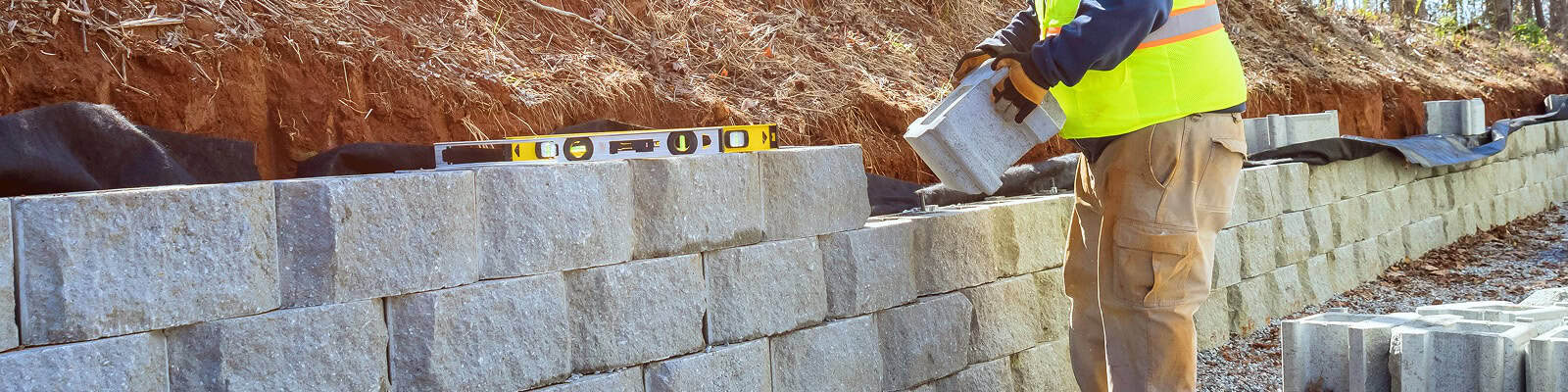
Retaining walls are one of the most misunderstood structures in residential and commercial landscapes. They look simple to build; you stack some block, add some gravel, maybe a drain tile and call it good. But anyone who has built or repaired enough walls knows the truth: a retaining wall is an engineered structure and the forces acting on it don’t care how nice the block looks on day one.
The number one reason a retaining wall fails isn’t the block, the footing or even the workmanship. It’s water, and the failure to control it.
Whether you’re a homeowner planning a DIY project or a contractor educating clients, understanding drainage and backfill is the difference between a wall that lasts 30 years and one that leans in three.
The Hidden Enemy of Retaining Walls: Lateral Pressure
Soil isn’t static. It expands when wet, contracts when dry, and exerts constant lateral pressure on anything holding it back. When water gets trapped behind a wall, that pressure increases dramatically. A wall that could easily hold back dry soil becomes overwhelmed when saturated.
In Iowa, our soil isn’t just dirt—it’s expansive clay, and that changes everything. Clay holds water like a sponge. When it gets wet, it swells. When it dries, it shrinks. That constant movement puts enormous pressure on retaining walls, especially during freeze-thaw cycles.
Without proper drainage and backfill, even a well-built wall can lean, crack or collapse. Backfill isn’t the dirt you dug out. It’s engineered material that allows water to move freely instead of building pressure. Proper backfill should include clean angular rock that extends a minimum of 12-18” back from the back of the block. It should also include separation fabric between the rock and native soil to prevent clogging the system. Using native soil or clay as backfill is a guaranteed failure point, because when it expands, it has enough force to push even well‑built walls out of alignment.
Drainage: The Lifeline of Every Retaining Wall
A retaining wall without drainage behaves like a ticking time bomb because water trapped behind the structure dramatically increases lateral pressure, especially in Iowa’s expansive clay soils that swell when wet and shrink when dry. Effective drainage starts with a perforated drain tile placed at the base of the wall and sloped to a proper outlet so water can be collected and redirected before it builds pressure. Free‑draining rock backfill allows water to move quickly down to that drain tile instead of soaking into clay, which would otherwise expand and push the wall outward.
Certain wall types, such as poured concrete or masonry, also require weep holes to release trapped water. The grading above the wall must shed water away rather than funnel it behind the structure, and surface drainage—like downspouts, sump discharge and yard runoff—must be routed away from the wall to prevent saturation. When all these components work together, the wall stays dry, stable and structurally sound despite the challenging soil conditions.
Geogrid: The Retaining Wall Reinforcement Most People Skip
For walls that are over 3–4 feet, have large slopes in front or behind or large loads behind the wall, geogrid is essential. It creates a single, reinforced mass behind the wall which becomes part of the structure holding any forces back from the wall. Global stability is a major concern for a wall built on a slope. Without geogrid, taller walls rely solely on block weight—which is rarely enough.
Proper geogrid installation requires selecting the correct grid type and strength, placing it at the specified intervals within the wall system, extending it far enough into the compacted backfill to create a stable reinforced mass and tensioning it before backfilling so it performs as intended. Skipping geogrid is one of the most common shortcuts in wall construction, and it often leads to long‑term structural failure.
Proper construction matters because a retaining wall is a long‑term investment that, when built correctly, prevents erosion, expands usable space, adds value, adds visual appeal and performs reliably for decades. When built incorrectly, however, it quickly becomes a safety hazard, a maintenance headache and often a costly reconstruction project. The difference between a wall that lasts and one that fails almost always comes down to proper drainage and backfill—not the block itself.
Building a Successful Retaining Wall
A retaining wall is more than a stack of blocks. It’s a structure designed to resist constant, powerful forces. Understanding how water moves, how soil behaves and how to engineer proper drainage is the foundation of a wall that stands the test of time.
📞 Connect with our design team: 515-987-4394
🌐 See photos of our recent projects: https://rjlawnservice.net/gallery/